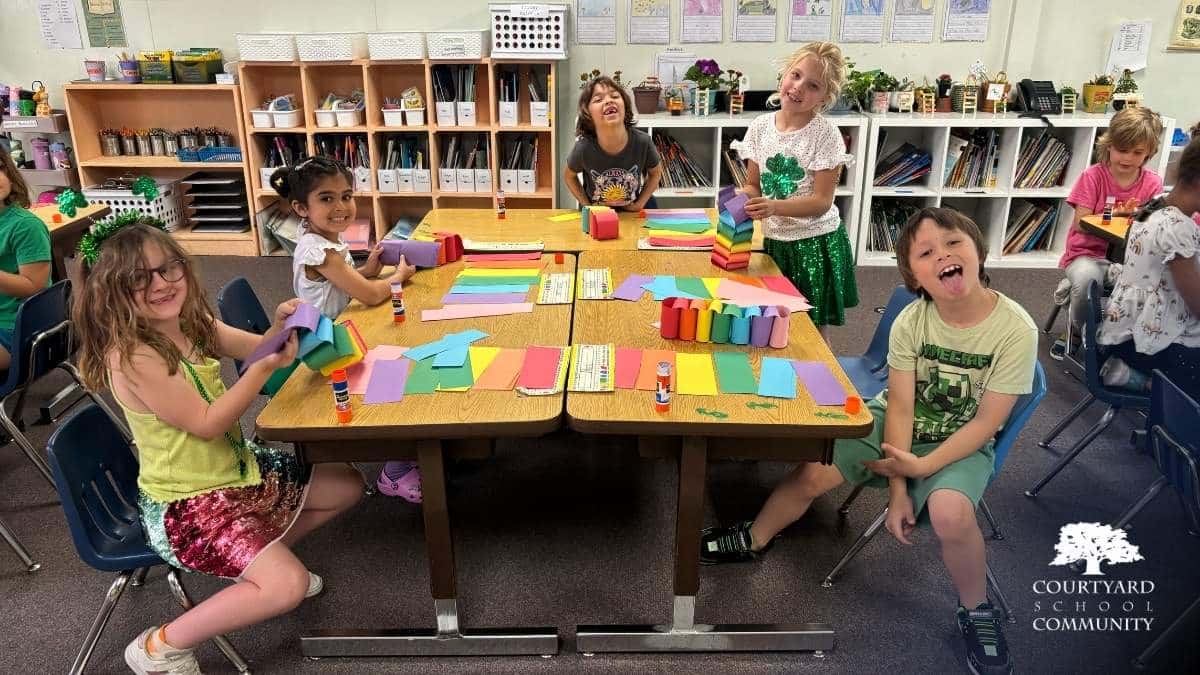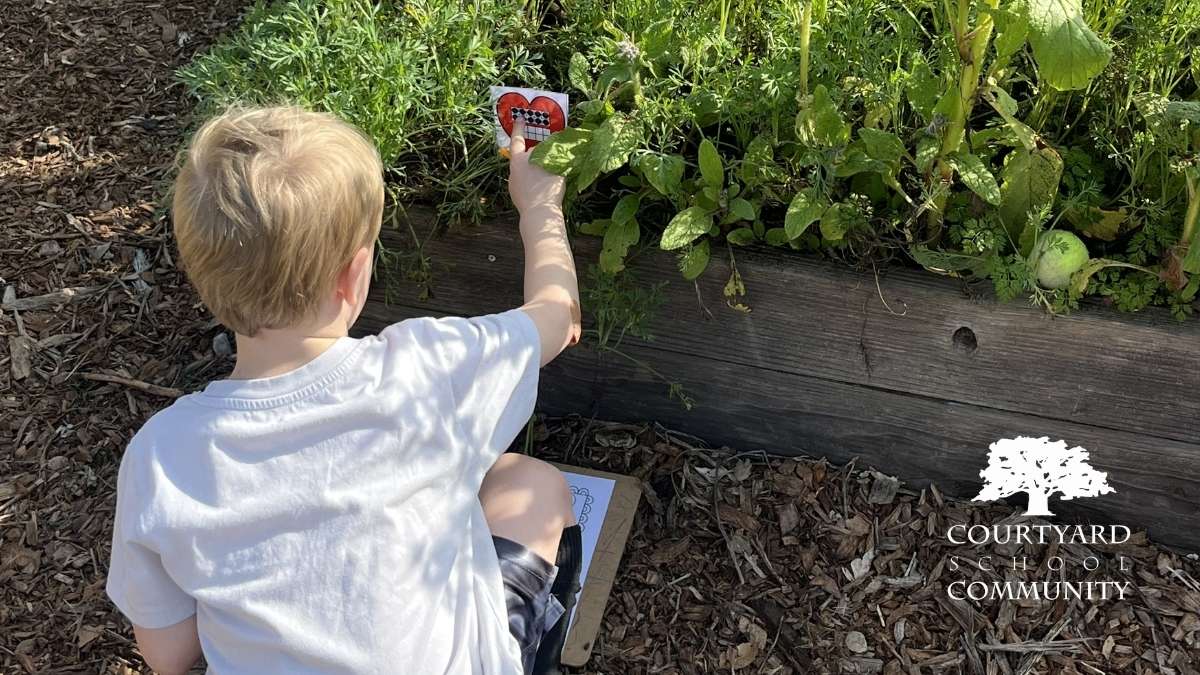
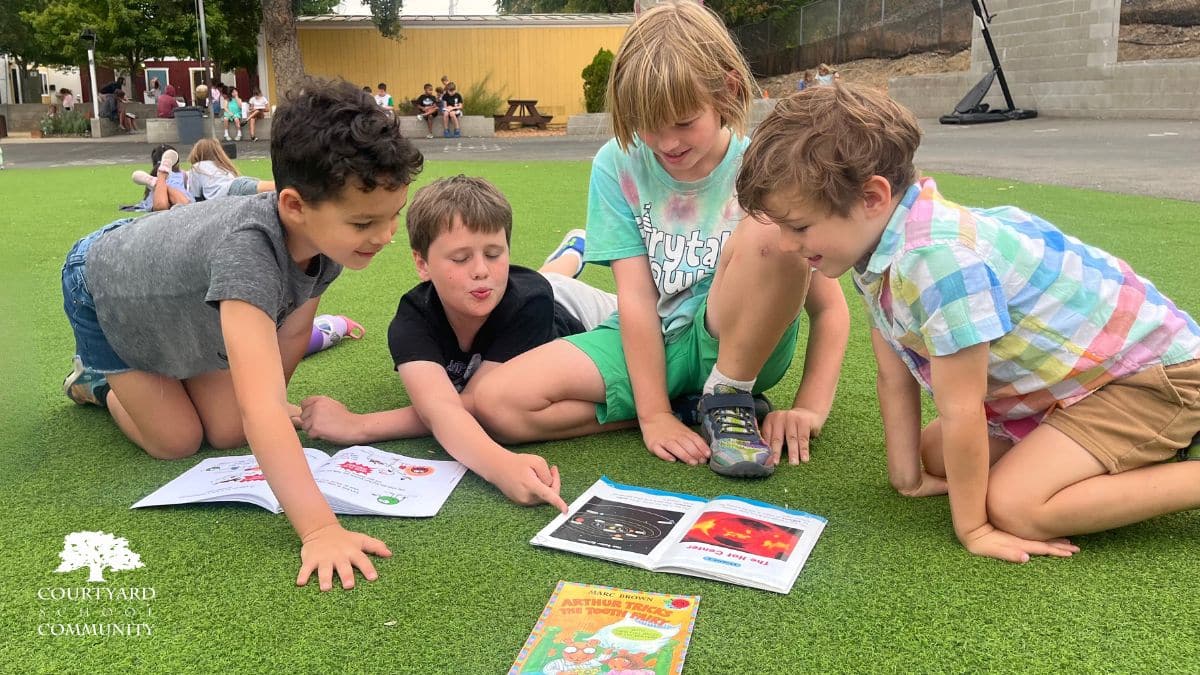

School websites are very good at telling you what they believe, but they aren’t great at giving you the day-to-day details.
And that is what you’re actually buying. Not the mission statement, but the hundreds and thousands of days your child will spend inside that building. The parts they stop telling you about as they get older, and that almost nobody thinks to share or photograph. So here’s what a day at Courtyard looks like, start to finish, including the things you don’t usually see in a brochure.
7am: The slow start
The first kids through the gate are the early ones, dropped off on the way to a shift or a commute that isn’t possible without an early start. Our before-care isn’t a holding room, it’s just a quieter version of the school. There are books, drawing, and the ongoing diplomatic crisis over whose turn it is with the good markers. Breakfast is out for kids who want it.
This is the hour that decides whether a school is a real option for a working or busy family. A school that opens at 8:20 sharp is a different logistical proposition than one that opens at 7, and it’s something I know Courtyard parents really appreciate: an early start that feels like a worthwhile place for our kids to be.
8:30am: The day begins
This is when the shift happens. Kids find their rooms, and the morning starts with the usual business of getting a class oriented. Attendance, announcements, whatever happened at recess yesterday that still needs sorting out before anyone can concentrate.
Then academics. For the older kids, this is where the multi-age structure begins: third and fourth graders are together in one room, fifth and sixth in another, and seventh and eighth in yet another, working in groups set by where each kid is in that subject rather than the grade in their file. (Read more on how that works and why we do it.) A strong reader doesn’t sit through a lesson they finished last year, and a kid who needs another pass at fractions gets one with no label attached.
Mid-morning: The parts that aren’t core academics
Spanish, music, drama, visual arts, PE. Not as a reward for finishing another subject, and not billed later as an add-on. Part of the week, the same way reading and math are part of the week.
This is more important than it sounds. Elementary and middle school are when kids find the thing they’re drawn to, and a lot of times it’s not a core subject. The one who discovers they can sing, or build, or make a room laugh during a play needs somewhere for that discovery to happen, and it’s not going to happen during fractions.
Lunch: In the courtyard the school is named after
Hot lunch is made on site, and it’s included in tuition, and so is the afternoon snack. Kids eat, then head out into the courtyard for the part of the day most of them would tell you is the best part.
One thing to notice on any tour: who’s outside with the kids during recess, and whether they seem to know which kid needs a nudge into the game. For a kid who’s an observer, like mine, this can make a big difference.
Afternoon: The long stretch
More academic blocks, project work, and the parts of the curriculum that need room to breathe. A science investigation that can’t be done in twenty minutes, a piece of writing on its third revision, or a California history project taking over reading, writing, science, and a suspicious amount of math time.
This is also where a small school really shines. In a room of twelve or fifteen kids, a teacher notices who’s tired after lunch and does something about it before parent/teacher conferences roll around. (More on what class size really changes.)
3:05pm: And the part most schools don’t talk about
The academic day ends, but only one-quarter of the building goes home.
What happens next is the difference between real after-school care and supervised waiting. There’s a snack, and then homework time for kids who’d rather not carry it home. There are clubs, there’s outside time, art, and the slow unstructured hours where a lot of friendships are made, the ones that don’t come from a classroom or don’t fit into a scheduled block.
6pm: How the day adds up
Eleven hours, if you use all of them. Most families don’t, but the ones who do really need it to exist: they need it to be included in tuition, rather than billed by the hour, and they need it to be worth their kid’s time.
That’s the real case for a full-day school: not that longer is better, or more helpful, or unavoidable, but that the hours your kid will spend there are hours worth having.
But is a full-day school right for your family?
A long day isn’t always a good day, and it isn’t right for every family. Plenty of kids do better with a shorter day and an afternoon at home, and if that’s your situation, a school built around a 7am–6pm schedule is solving a problem you don’t have.
The question isn’t how many hours a school offers, it’s what happens during that time. Which is why the only real way to answer this is to walk in and look, ideally at 5:15, not 10am. (Take a look at our guide for touring schools, if that’s useful.)
Stop by and see us
Courtyard is a TK-8 independent school in Midtown Sacramento with about 135 students, multi-age classrooms after second grade, and the day described above. TK and Kindergarten are full for this year, but there are open seats for first through eighth grade.
You can schedule a visit on our website or call us at (916) 442-5395. Ask to come at pickup time, or anytime. We’d rather you saw the real thing.